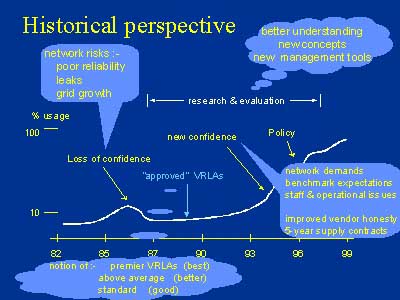
If we look at the usage rate of VRLA batteries over time, it looks something like this.
Notice that the experience goes back to very early 80s and that now, usage is nearly 100%. However, to put everything in context, the curve has a number of characteristics I need to explain.
First, Telstra’s “fingers got burnt” after a fairly rapid rate of integration (no doubt after believing the promises of maintenance free and 10 year life) in the early ‘80s. And that was a massive loss of confidence in the technology for high reliability applications.
However, from a network point of view the need for equipment-compatible VRLAs was obvious and it was not possible to just walk away from the technology. So a substantial program of investigation into VRLA battery technology was initiated.
I was important that the User “could get on with business”, and in about 1989, as a result of the evaluation program, a list of VRLA batteries available for use in the network was released. The list was in the notion of “good, better, best”. Their use linked to applications, and was monitored, with the intention of improving the list.
After a few years, confidence with VRLA increased, such that by about 1996, it had become policy that VRLAs’ were the technology of choice.
There were many non-technical aspects to this policy, the most important being a new level of supplier honesty, and the letting of 5-year supply contracts. Among other things this mean that the supplier would have to wear and suffer Telstra’s wrath for at least five years if the product was not up to scratch.